Exploring the remarkable legacy of one of Karytaina’s most influential families, from Venetian rule through the Greek War of Independence
In the shadow of Karytaina’s ancient castle, where the Alpheus River winds through the Arcadian mountains, few families have left as indelible a mark on local history as the Koulas family. Through the research by Scobie Demetrios Kostopoulos and Giannis Antoniou Antonopoulos, we can now trace the remarkable journey of this influential dynasty that shaped Karytaina’s destiny for over two centuries.

The Foundation: Anastasios Koulas and His Legacy
The Koulas family story begins with Anastasios Koulas, the patriarch whose son would become one of the most powerful figures in the Peloponnese.¹ While details of Anastasios himself remain scarce in the historical record, his legacy lived on through his remarkable son, who would earn both fame and infamy in equal measure.
The Enigmatic Captain: Thanassis Koulas (Zantes)
A Man of Two Worlds
Athanasios “Thanassis” Koulas, also known as “Zantes”, emerged as one of the most complex figures in Karytaina’s history.¹ Born before 1700 to Anastasios Koulas, he navigated the treacherous political waters between competing powers with remarkable skill and adaptability.
During the late 17th century, in the era of Francesco Morosini’s campaigns, Captain Thanassis distinguished himself in military service to the Venetians.² His contributions were so significant that the Venetians rewarded him with the coveted position of Captain of Karytaina – a testament to both his military prowess and political acumen.¹
The Art of Survival
Thanassis Koulas’s diplomatic skills became evident in 1715, when the tide of power shifted dramatically.³ As the Venetians retreated from the Morea, many of their Greek allies faced persecution or death. However, Thanassis managed to secure his position under the new Ottoman administration, serving Ali Kiumourtzis and earning appointment as Armatolos of Karytaina.¹
This transition speaks to more than mere opportunism – it reveals a man who understood that survival often required pragmatic adaptation, especially when responsible for protecting his family and community.
A Life of Remarkable Wealth and Influence
The extent of the Koulas family wealth was legendary throughout Arcadia.¹ Thanassis owned thirty estates (tsifliks) stretching from the village of Pyri to Ibrahim, covering vast territories across Iraia and Gortynia. His properties extended from Mount Erymanthos to Karytaina itself, making him one of the region’s largest landowners.
His influence was so considerable that he possessed special firmans allowing him extraordinary privileges, including the right to wear a yellow cap and special sandals even in the presence of the Pasha in Tripoli – honors rarely accorded to Christian subjects.¹
The Philanthropist
- 1700: Donated twenty grosz to the Monastery of Philosophos for construction of the refectory
- 1705-1713: Funded the iconography of the Church of the Assumption in Kalami Atsicholo
- 1730: Dedicated his extensive estates in Markos village (south of Dimitsana and near Zatouna) to the Monastery of Philosophos
- 1730: Contributed to the decoration of the Church of Saint Demetrius the Myrrh-Bearer in Megalopolis
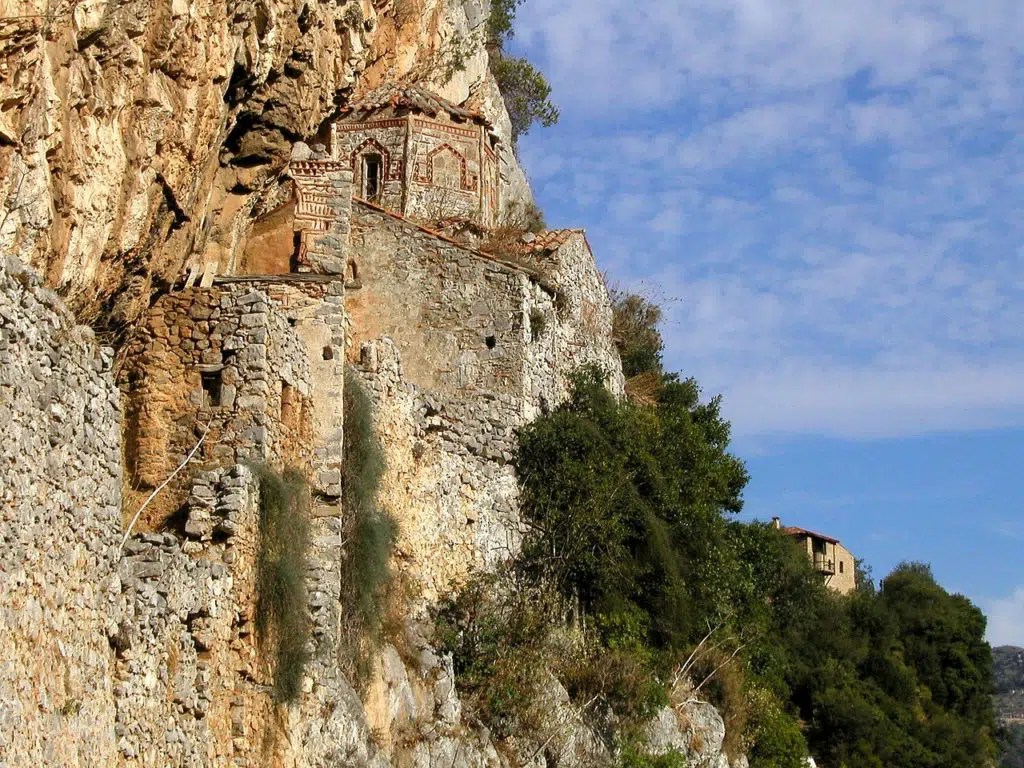
Despite the controversies surrounding his political accommodations, Thanassis Koulas demonstrated generosity toward religious institutions:¹
A Sacred Trust
One of Thanassis’s most significant acts was his role in protecting religious heritage.¹ Recognizing the instability of his times, he personally transported the relics of Saint Athanasios Christianoupoleos from Christians in Messinia to Agiannis Prodromos for safekeeping – a prescient act that preserved these sacred remains for future generations.
A Tragic Death
The circumstances of Thanassis Koulas’s death reveal the dangerous complexities of his position.¹ In a property dispute with Lalaios Moulas, a Turkish mullah, over estates near Mount Erymanthos, Thanassis struck his opponent with his sandal before the Pasha. When the Pasha failed to provide justice to the Turkish claimant, two assassins were sent on Holy Thursday to Thanassis’s tower near Karytaina’s ancient bridge.
The aftermath became the stuff of local legend: the assassins placed Thanassis Koulas’s severed head in a saddlebag, tied the horse’s bridle to prevent grazing, and sent the animal home to Karytaina. When a servant opened the saddlebag expecting supplies, she discovered the tragic news that would end an era.
Family Connections
The Koulas family’s influence extended through marriage alliances with prominent families.¹ Thanassis’s sister married Antonios, brother of Saint Athanasios of Christianoupoleos of Karytaina, while his grandson became Metropolitan of Lacedaemon Ananias. One daughter became a nun, establishing a monastic wing in Kalamata where she served.
The Revolutionary Generation: Spilios Koulas
Inheriting a Complex Legacy
By 1821, Spilios Koulas had inherited both the family’s prominent position and its complicated relationship with authority.² Serving as a kotzambasis (community leader) in Karytaina, he initially found himself caught between old loyalties and revolutionary fervor.
Early Hesitation and Awakening
Unlike many of his contemporaries, Spilios was not initially initiated into the Filiki Eteria (Society of Friends) – the secret organization that planned the Greek Revolution.⁴,² This exclusion likely reflected suspicions about his family’s historical accommodations with Turkish authorities.
When the revolution began, Spilios initially viewed the uprising as “mere brigandage without significance” that would quickly pass.² Together with Gero-Michelis Komitas, he even advised local Turks to remain in the castle rather than flee to Tripoli, believing this would provide better protection for all parties.
The Transformation
However, as the scope and seriousness of the revolutionary movement became clear, Spilios underwent a transformation.² Recognizing that this was indeed a national liberation movement, he began recruiting throughout the region and committed himself fully to the cause.
Military and Administrative Service
By April 1821, Spilios had been appointed to the “Ephorate of Karytaina“ – a crucial supply and coordination committee for the revolutionary forces around Tripoli.² This organization proved invaluable in providing food, ammunition, and other necessities to Greek fighters.
Working with Revolutionary Leaders
Spilios collaborated closely with prominent figures including:²
- Kanellos Deligiannis (under whose presidency he served)
- Theodoros Kolokotronis (the legendary military leader)⁵
- Spyros Karydis (fellow Ephorate member)
Together, they signed crucial documents and decisions of the Provincial Assembly of Karytaina, meeting at the Monastery of Saint Theodore in Pyrgaki of Vytina.²
The Continuing Mystery: Family Folklore
The Servant’s Curse
One of the most intriguing aspects of Koulas family history involves a story passed down through Anastina Spiliopoulos (aged 85), who heard it from her father-in-law Georgios Spiliopoulos.² According to this account, Spilios Koulas and his wife Roubina lived in Florio and mistreated a servant who was forced to leave their service.
Years later, the servant returned to find his former employers in dire straits, with Roubina crying while baking bread. Taking pity on them, the servant performed what locals considered a ritual cleansing, using salt, oregano, and water while saying, “As salt melts, so may the curses melt too.“
From that day forward, according to legend, the family’s fortunes improved dramatically, and the village became known as “Florio” (from “florin,” meaning wealth).²
Historical Impact and Legacy
Beyond Individual Achievement
The Koulas family story illuminates broader themes in Greek history:
Political Adaptation: Their ability to serve under Venetian, Ottoman, and revolutionary governments demonstrates the complex choices faced by community leaders during periods of imperial transition.
Economic Influence: Their vast landholdings and wealth show how certain Greek families maintained economic power even under foreign rule.
Religious Patronage: Their extensive donations to monasteries and churches reflect the important role of wealthy families in preserving Orthodox Christian culture.
Revolutionary Participation: Spilios’s evolution from skeptic to committed revolutionary illustrates how the 1821 movement eventually united Greeks across social and political divisions.
Architectural Heritage
Evidence of the family’s prominence remains visible today in Karytaina.¹ Thanassis Koulas’s tower, located near the ancient bridge over the Alpheus River, included sophisticated amenities such as specialized ceramic pipes that delivered perfumes to his private bath – a luxury that demonstrated both wealth and cultural refinement.
Acknowledging Our Sources
This exploration of Koulas family history has been made possible through the dedicated scholarship of:
Scobie Demetrios Kostopoulos, author of “Καρύταινα: Τα Πρόσωπα και Η Ιστορία Ενός Τόπου, Τόμος Α'” (Karytaina: The People and History of One Place, Volume A), published in Kalamata, 2017. Pages 110-112.
Giannis Antoniou Antonopoulos, author of “Καρύταινα, το Μετερίζι του ’21” (Karytaina, the Sacred Struggle of ’21), with editions published in Athens in 1971, 1988, and 1994. Pages 54-56.
These historians have shared research from crucial primary source material, including monastery codices, government archives, and oral traditions that might otherwise have been lost to time.
Connecting Past and Present
For descendants of the Koulas family and other Karytaina families, these stories provide more than historical interest – they offer insights into the character, challenges, and choices that shaped our ancestors’ lives. The Koulas family legacy reminds us that history is rarely simple, and that understanding our heritage requires appreciating both achievements and contradictions.
Their story continues to unfold through genealogical research projects like the Karytaina Ancestry Project, which seeks to document and preserve the intricate family connections that bind this remarkable mountain community together across centuries.
Questions for Further Research
As we continue exploring Karytaina’s rich family histories, several questions about the Koulas lineage remain:
- What became of the various Koulas branches after the revolution?
- How did the Koulopoulos branch of the family develop?
- What connections exist with other prominent families like the Spiliopoulos line?
- Are there surviving documents or artifacts from the family’s extensive properties?
The Karytaina Ancestry Project welcomes contributions from researchers, descendants, and anyone interested in preserving the rich heritage of this historic mountain community. If you have information about the Koulas family or other Karytaina families, please contact us through our website.
Footnotes
- Kostopoulos, Scobie Demetrios. Καρύταινα: Τα Πρόσωπα και Η Ιστορία Ενός Τόπου, Τόμος Α’ (Karytaina: The People and History of One Place, Volume A). Kalamata: 2017, pp. 110-112.
- Antonopoulos, Giannis Antoniou. Καρύταινα, το Μετερίζι του ’21 (Karytaina, the Sacred Struggle of ’21). Athens: 1971, 1988, 1994, pp. 54-56.
- Greek Castles – Karytaina. “After a brief period of Venetian rule (1687–1715), Karytaina returned to Ottoman control.” Accessed 2025.
- Historein Journal. “Filiki Eteria (Society of Friends) was the secret organization responsible for planning the Greek War of Independence.” Accessed 2025.
- Greek Reporter. “Theodoros Kolokotronis (1770-1843) was one of the most prominent leaders of the Greek War of Independence, known as the ‘Old Man of the Morea.'” Accessed 2025.
Sources and Further Reading
- Antonopoulos, Ioannis. Καρύταινα, το Μετερίζι του ’21, Athens: 1971, 1988, 1994.
- Kostopoulos Skompy-Dimitrios. Καρύταινα: Τα Πρόσωπα και Η Ιστορία Ενός Τόπου, Τόμος Α’, Kalamata: 2017.
- Χρυσανθόπουλος, Φώτιος ή Φωτάκος (1798-1878) (Fotakos), Απομνημονευματα περι της Ελληνικης επαναστασεως (Biographical Memories of the Greek War of Independence).Τυποις Π. Σακελλαρίου, Athens: 1858.
- Archives of Philosophos Monastery, Karytaina
- General State Archives of Greece, Ministry of War records
 Karytaina Ancestry
Leave a comment